Advocating for Equity: After School Tutor at East African Community Services



Overview
My first volunteer experience as a college student was as an After School Tutor at East African Community Services (EACS). I got involved with this organization through ENG 121 which is a service-learning course I took my freshman year. The purpose of service-learning is to challenge UW students to be active members of their community by working with a specific organization. While volunteering in this role, I helped elementary aged students with their homework, motivated them to stay on track with their classwork, and established a culturally inclusive space. This gave me meaningful experience working with children which expanded my knowledge on the education field.
Personal Importance of Work
Nearly all of the students I worked with at EACS were of East African descent. Being exposed to such a diverse learning environment gave me the opportunity to recognize the need for more culturally sensitive places. Allowing students a safe space where they have access to resources is a significant support to their academic success. This eye-opening experience enhanced my passion for empowering students and advocating for equitable education. It also inspired me to seek deeper insight about how to support these communities by pursuing a degree in ECO (Education, Communities, and Organizations).
Tasks Accomplished
-
Attend an orientation at service-learning location
-
Work one on one with students on their homework
-
Check/ correct assignments
-
Reteach/ clarify the material
-
Problem solve/ work through questions step by step
-
-
Play with the kids (i.e. board games, puzzles, tag, etc.)
-
Read aloud with students
-
Promote a diverse environment through culturally relevant music and readings
-
Listen to understand the students and their lives
-
Maintain a friendly and positive attitude by supporting students through any frustrations they may experience
-
Encourage students to focus on their work
-
Hand out snacks
-
Reflect on my participation through coursework and discussion in ENG 121 class
Leadership Competencies Gained
Diversity
I encountered a language barrier between myself and a couple of siblings who were enrolled in the After School Program. I only spoke English while they were fluent in Swahili and only understood a limited amount of English. Despite this barrier, they were eager to have me read aloud English picture books to them. Although we could not have a verbal conversation, we still communicated effectively. These students wanted to learn English however, they were never discouraged from speaking their native language. At EACS, it is expected for people to respect one another regardless of their background. This is a life lesson that can be applied to any social environment. While English may be the dominant language in America, it should never be the only language spoken. Diversity should always be encouraged by society rather than avoided.
Inclusion
Inclusion is a main component of the mission statement at EACS. Their organization provides services such as Adult Citizenship Classes, a women empowerment program, ELL (English Language Learning) assistance, a Youth Leadership Council, and East African Cultural History and Practice nights. As a student mentor, I assisted their academic success, supported their self-image, and their career exploration. Being involved with this organization gave me a deeper understanding of East African Culture as well as it allowed me to help them become more familiar and appreciative of their own culture. Following the values at EACS, I want to govern my work in a way that allows people of any background to participate and have their voices be heard.
Empathy
When the kids arrived at the After School Program, they would have free time to play before it was time to sit down and start on homework. On sunny days the kids preferred to go outside rather than play board games indoors. The outdoor activity that appeared to be the most popular was making up a dance or cheer performance. The students would establish their teams, come up with a routine, and then “compete”. One day I noticed a girl was watching her classmates dance but was not a part of the game herself. Thinking back on my childhood, I could relate to the feeling of wanting to be included but being too shy to initiate it. I offered to be on a team with her so that we could participate with our own dance act. Soon enough, she had no problem fitting in because everyone wanted to be on our dance team. This situation taught me that it can be worthwhile to step out of my comfort zone in order to make others feel more comfortable.
Empowerment
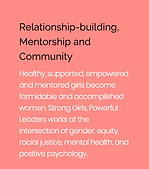
One aspect of EACS that I resonate strongly with is their dedication to empowering women. They recognize the intersection of racism, sexism, and xenophobia that members of their community are facing. In retaliation to this maltreatment, they started a program titled “Strong Girls, Powerful Leaders”. Through my mentorship with the students at the After School Program, I was able to discuss my experiences being a woman in higher education. They were curious about the college campus, the classes I was taking, and the opportunities and activities that were offered at the UW. I was excited to share my stories to empower them to strive and obtain a college level education or any other goal they might have for the future. Sharing knowledge is important for any community or organization to thrive as it can be a learning opportunity for others.
Helping Others
The majority of my time spent at EACS went to homework help. At first, this task was daunting because it was up to me to explain and clarify the concepts that the students had learned in school and I did not want to be responsible for teaching it incorrectly. However, after viewing numerous math, reading, and writing assignments the methods came back to me. Whether it be rounding numbers, fractions, multiplication, or division I was able to relearn how to explain it in terms that would make sense to elementary schoolers. This required a high level of patience and the ability to find the specific point of confusion and thinking of an alternative way to teach it. These skills will be helpful in an environment where I need to teach others about a topic in a way that accommodates their background knowledge so that it makes sense to them.
Listening
Looking back on my involvement at EACS, there is one student who stands out. This student was particularly open and vulnerable with me which is not a bond that I had originally expected to make whilst providing homework help. She described the bullying and discrimination that she had undergone in her public school. I listened to everything she had to say and reminded her that at EACS she would never be treated that way and that she should ignore all the mean comments. She impressed me with her confidence in dealing with these negative comments, but this conversation truly made me realize what a safe haven EACS was for some of the students. This student taught me the importance of educating every member in the room on cultural sensitivity and acceptance in hopes of reducing any preconceived biases and ignorance.
Problem Solving
The biggest challenge I faced at this organization was the task of keeping the students focused. One day, a student who I worked with sat under his desk and refused to do any work. I tried asking him nicely to cooperate, I tried bribing him with the option of free time after he finished his work, along with every other strategy I knew. In the end, I resorted to simply asking him what he needed in order to concentrate. He requested that another volunteer and I sing a duet for the class. It began as a random request, but over the next few weeks turned into our go to strategy for motivating the students. This situation reminded me that even if a student comes across as difficult, it is important to listen to them and to be able to find a fun way to provide an incentive for them.
Future Oriented Statement
The knowledge I gained throughout this experience goes beyond the classroom environment. Establishing safe and accepting spaces in every community, not just for students in a classroom, is crucial for every society. The combination of this experience with being an ECO major and Diversity minor has taught me the importance of listening to and learning from others and acknowledging every identity as valid and important. I will do my best to support and advocate for underrepresented groups especially within the education system.
Click here to read a reflection I wrote on my experience at EACS.
I go into depth about the progression of the relationships I built with the students as well as the ways in which the skills I gained are applicable to other aspects of life.

Click photo to enlarge